Expertise and Interests
His research interests lie in Bayesian and computational statistics, with a particular focus on the development and application of methods in R-INLA.
His research interests lie in Bayesian and computational statistics, with a particular focus on the development and application of methods in R-INLA.
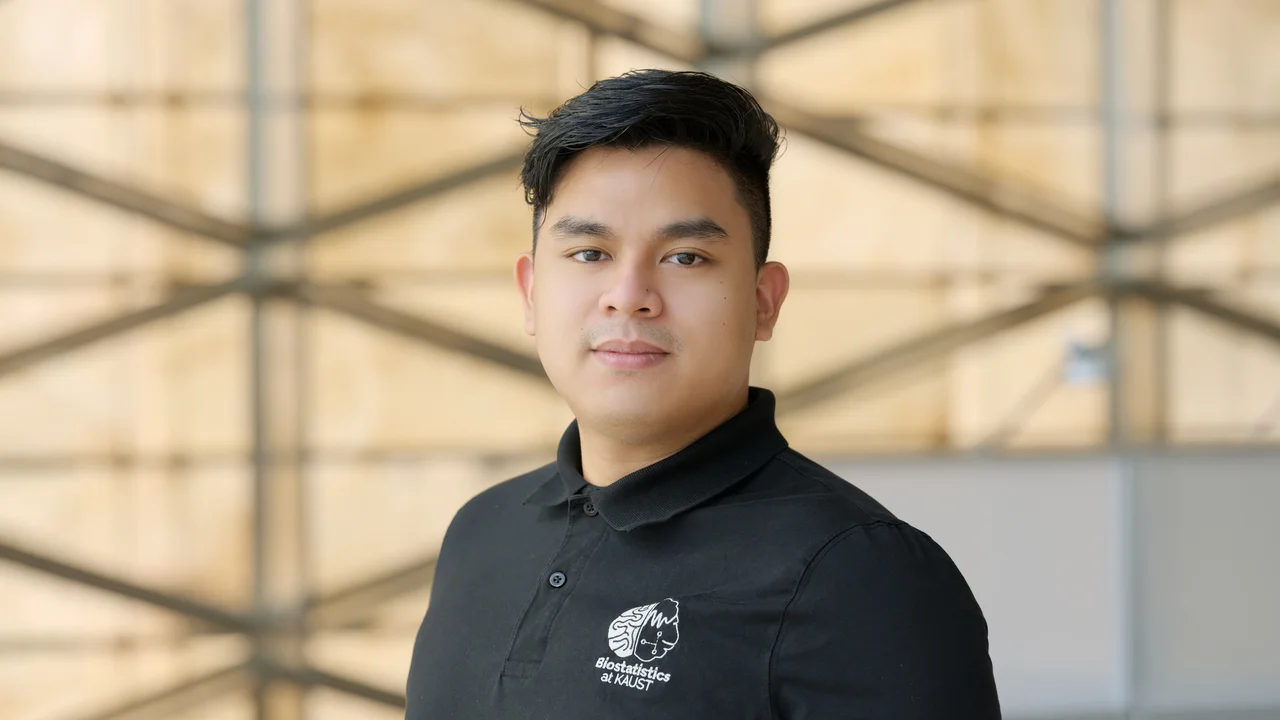
Paolo Redondo obtained his B.S. and M.S. degrees in Statistics from the University of the Philippines Diliman. He is a member of the Biostatistics and Extreme Statistics research groups.
Paolo's research focus on developing methodologies to characterize nonlinear dependence in brain networks and to understand the tail behavior of brain dynamics during abnormal events such as epileptic seizures.
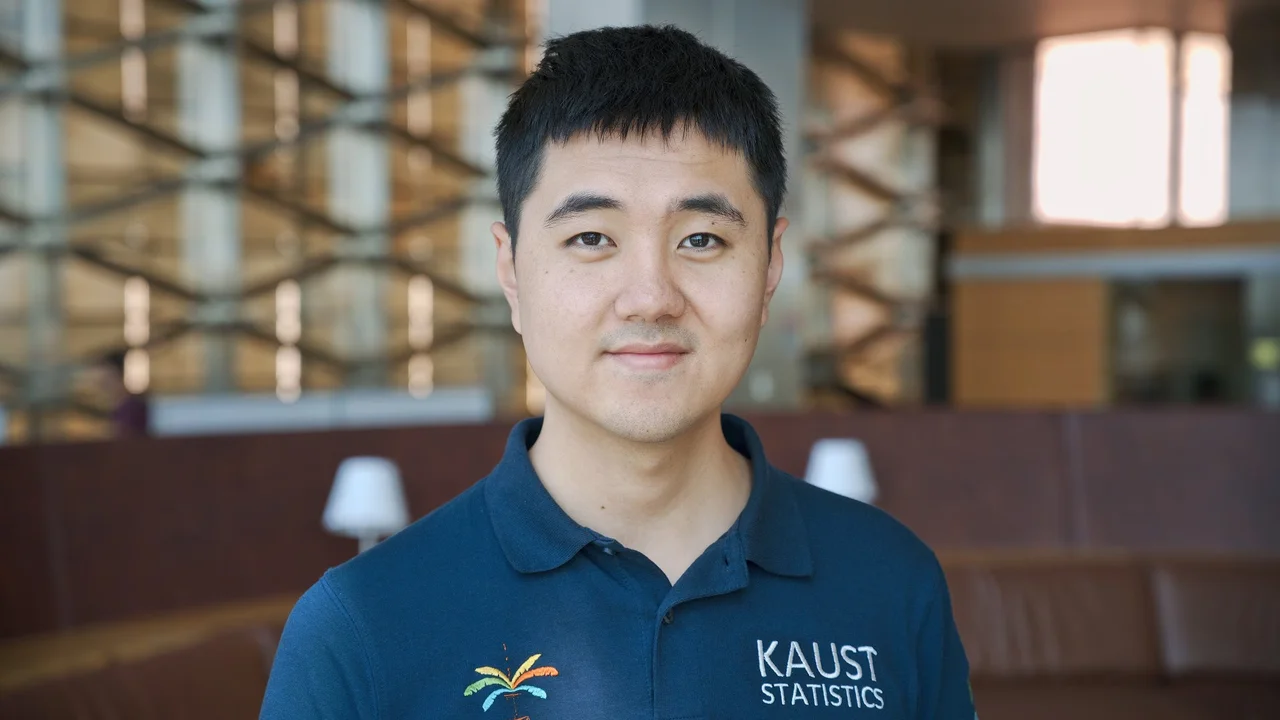
Qilong Pan is a Ph.D. candidate in Statistics at KAUST, supervised by Prof. Ying Sun. His research focuses on scalable Gaussian Process modeling, high-performance statistical computing, and GPU-accelerated inference for large-scale spatial and computer experiment data.
Qilong Pan's work bridges statistical modeling, optimization, and high-performance computing (HPC) to tackle complex challenges in geospatial analytics and machine learning. He develops efficient algorithms and software for Vecchia-based approximations, aiming to enable practical Gaussian Process applications on modern supercomputers.
His research interest is mainly in Bayesian and computational Statistics, currently working on Directional Statistics and applications with R-INLA. He is also interested in Deep/Machine Learning algorithms.
Xiran Zhang is a Ph.D. candidate in Statistics at King Abdullah University of Science and Technology (KAUST). He received his B.S. in Mathematics and Applied Mathematics from the University of Science and Technology of China (USTC) in June 2021 and his M.S. in Statistics from KAUST in December 2022. His research lies at the intersection of statistics and high-performance computing, with a particular focus on scalable methods for large-scale geostatistical and spatio-temporal problems. Key words of his work include distributed CPU/GPU computing, parallel algorithms, uncertainty quantification for massive spatial data, and spatio-temporal cross-covariance modeling.
Xiran has his work published or presented at major international conferences, including IPDPS, JSM, and SC. In addition to his research, he has been actively involved in teaching and mentoring, serving as a teaching assistant for several STAT courses at KAUST and at King Fahad Security College for the Ministry of Interior. He has received several honors, including the Al-Kindi Statistics Top Quals Student Award in 2021 and the KAUST Dean’s List Award in 2024 and 2025.
During his doctoral studies, he has developed high-performance computational frameworks for credible and confidence region detection in massive geostatistical datasets, designed optimized implementations on distributed runtime systems such as PaRSEC and StarPU, and worked on GPU-accelerated scientific computing pipelines. He has also contributed to task-based parallel computing for statistical software through RCOMPSs, an open-source runtime system for R, and has collaborated with international research teams including the Barcelona Supercomputing Center and the University of Colorado Denver.
Yang Xiao is a Ph.D. candidate in Statistics at King Abdullah University of Science and Technology (KAUST). With a background that bridges rigorous mathematical theory and industrial application, his work focuses on improving the accuracy of real-time predictive modeling in high-stakes environments.
Before joining KAUST, Yang spent several years as a Statistician in the pharmaceutical industry, where he specialized in experimental design, protocol development, and ensuring 100% numerical reproducibility for core research frameworks under strict regulatory standards. His academic journey began with a dual-degree background in Applied Statistics and Actuarial Science, followed by an MSc in Statistics with Data Science from the University of Edinburgh, where he focused on multi-modal signal extraction and latent pattern recognition in epidemiological data.
Yang’s research focuses on the intersection of Bayesian Hierarchical Modeling and high-performance algorithmic optimization. He is particularly interested in leveraging latent Gaussian processes and signal decomposition to drive superior predictive outcomes in both public health and quantitative finance.
Ziling is a doctoral student in Statistics at King Abdullah University of Science and Technology (KAUST), where she is conducting her research under the mentorship of Professor Hernando Ombao in the Biostatistics research group and Professor Ying Sun in the Environmental Statistics research group. Ziling Ma earned her Bachelor's degree in Mathematics and Applied Mathematics from Tianjin Normal University in China. She then furthered her education at KU Leuven in Belgium, where she was awarded a Master's degree in Mathematics. Ziling embarked on her Ph.D. journey in Statistics in August 2023.
Ziling Ma's research interests are situated at the crossroads of time series analysis, robust statistics, and functional data analysis.
Anass ElYaagoubi is a statistician, data scientist, and researcher currently based at King Abdullah University of Science and Technology. He earned his Ph.D. in Statistics from KAUST under the supervision of Hernando Ombao, focusing on topological and statistical analysis of brain time-series data. His academic work spans machine learning, topological data analysis, neuroscience, and high-dimensional statistical modeling, with publications in journals and conferences across statistics, AI, and computational neuroscience.
Before joining KAUST, he studied information systems engineering and data science in France at National Institute of Applied Sciences of Rouen and University of Rouen Normandy. Over the years, he has worked on projects involving biomedical signal analysis, natural language processing, search systems, and AI-enabled educational platforms. He has also taught statistics, machine learning, and programming to large academic and industry audiences, including collaborations with Saudi institutions and industry partners.
His broader vision is to bridge rigorous mathematical research with impactful technological tools that can improve scientific discovery, learning, and human understanding.
Eman Kabbas is a Saudi researcher specializing in Bayesian statistics and modeling. She earned her Bachelor’s degree in Mathematics from Imam Abdulrahman bin Faisal University, then continued her studies in the United States through the King Abdullah Scholarship Program, obtaining a Master’s degree in Applied Mathematics from the University of North Carolina. Supported by scholarships from KAUST and the Royal Commission of Jubail and Yanbu, Eman is currently a PhD student in Applied Mathematics and Computational Science (AMCS) at King Abdullah University of Science and Technology (KAUST), supervised by Professor Håvard Rue. Beyond her research, Eman is a Mathematics and Statistics faculty member at Jubail Industrial College under the Royal Commission of Jubail and Yanbu, and co-founder of Sorat Alardh, a startup advancing environmental monitoring and climate analytics. She envisions combining theory and real-world application by transforming scientific research into practical tools that enhance environmental resilience and data-driven innovation in Saudi Arabia. Eman enjoys reading, learning new languages, playing the piano, and exploring strategic games like chess.
Eman Kabbas's research interests focus on developing and applying spline models in non-parametric regression. She addresses the limitations of splines in prediction tasks with insufficient data by proposing a spline model suitable for both regular and irregular observations, leverages Bayesian techniques to ensure efficient modeling and reliable predictions.
Esmail Abdul Fattah holds a Ph.D. in Statistics from KAUST, where he is now a postdoctoral researcher in high-performance computing. His work connects the two fields to scale Bayesian inference, bringing HPC to approximate methods such as INLA. This includes GPU-accelerated sparse factorizations and selected inversion for structured matrices through the sTiles framework, and extending INLA to non-sparse models. He also works on applications in spatial and spatio-temporal disease mapping.
More information: https://esmail-abdulfattah.github.io
Fernando Rodriguez Avellaneda is a postdoctoral researcher at King Abdullah University of Science and Technology (KAUST). He completed his Ph.D. in Statistics at KAUST in 2026 under the supervision of Professor Paula Moraga. He also holds an M.Sc. in Mathematics and a diploma in Artificial Intelligence from the National University of Colombia.
His doctoral research focused on Bayesian spatial and spatio-temporal modeling for environmental monitoring and epidemiology. His work included statistical methods for spatially disaggregating air-pollution data and estimating the velocity and direction of infectious-disease spread.
In his current research, Fernando develops statistical methods for ecological and fisheries data, with particular emphasis on coral-reef systems, reef-fish biomass, spatial ecological processes, and uncertainty quantification.
• Bayesian spatial and spatio-temporal statistics
• Bayesian hierarchical and latent Gaussian models
• Spatial disaggregation and change-of-support problems
• Environmental and ecological statistics
• Coral-reef ecology and fisheries
• Uncertainty quantification and propagation
Mary Lai Salvana is an assistant professor of statistics at the University of Connecticut. She earned her Ph.D. in statistics from King Abdullah University of Science and Technology (KAUST), Saudi Arabia. Before joining the University of Connecticut, she held a postdoctoral fellowship in the Department of Mathematics at the University of Houston. She received her bachelor’s and master’s degrees in applied mathematics from Ateneo de Manila University in the Philippines in 2015 and 2016, respectively.
Her research focuses on the statistical modeling of extreme and catastrophic events, risk and disasters, with an emphasis on spatial and spatio-temporal statistics, environmental and computational statistics, large-scale data science, and high-performance computing.