Nonlinear Optimal Control and Filtering beyond the HJB Equation Alessandro Astolfi, Professor, Applied Mathematics and Computational Science Nov 19, 12:00 - 13:00 B9 R2325 nonlinear optimal control optimal control Filtering theory PDEs non-linear feedback A novel set of sufficient conditions - equivalent to the HJB equation for the solution of nonlinear optimal control problems.
Mathematical and Computational Models of Fluid-Solid Interactions in the Subsurface Maryam Alghannam, Ibn Rushd Assistant Professor, Earth Systems Science and Engineering Nov 12, 12:00 - 13:00 B9 R2325 computational models fluid dynamics computational fluid dynamics
KAUST Statistics Research Day Nov 3, 08:55 - 16:30 B19, Hall1 Bayesian Statistics Biostatistics spatial statistics geospatial statistics computational statistics extreme statistics Join KAUST Statistics Research Day to explore the latest work by KAUST researchers in statistical modeling, machine learning, biostatistics and spatial analysis.
Bayesian Decision-Theoretic Privacy Christian P. Robert, Full Professor, Department of Applied Mathematics (CEREMADE), Paris Dauphine-PSL University; Nov 2, 12:00 - 13:00 B3 R5209 Data Privacy statistical privacy bayesian adversial privacy privacy-preserving machine learning privacy-preserving AI bayesian methods This seminar introduces two Bayesian decision-theoretic frameworks, persuasive privacy and Bayesian adversarial privacy, that quantify statistical privacy by evaluating how data releases influence adversarial beliefs and decisions while offering contextual alternatives to conventional differential privacy.
On the Difficulties of Assessing Statistical Privacy Christian P. Robert, Full Professor, Department of Applied Mathematics (CEREMADE), Paris Dauphine-PSL University; Nov 1, 12:00 - 13:00 B9 R2325 Bayesian Statistics statistical privacy privacy bayesian adversial privacy This distinguished lecture examines the limitations of statistical disclosure control and differential privacy and explores robust, deliberately insufficient statistics combined with Bayesian inference as an alternative approach to protecting individuals in shared data.
Fourier-Spectral Methods for the Vlasov-Poisson System Giovanni Russo, Full Professor of Numerical Analysis, Department of Mathematics and Computer Science, University of Catania (UNICT) Oct 29, 12:00 - 13:00 B9 R2325 Vlasov-Poisson system fourier spectral methods splitting methods adaptive methods In this talk we present an adaptive method for the numerical solution of the Vlasov-Poisson system in one space dimension with periodic boundary conditions in both space and velocity, which is based on Fourier discretisation in x and v and on high order fractional step method in time, allowing high accuracy and efficiency.
Saudi HPC/AI Conference 2026 Oct 26, 08:00 - Oct 28, 17:00 KAUST HPC AI big data Data Analytics machine learning artificial intelligence Join researchers, technology experts and industry leaders to explore how HPC and AI are advancing research and innovation.
Reading Theorems in Lean Diogo Gomes, Associate Dean for Students, Computer, Electrical and Mathematical Sciences and Engineering Oct 22, 12:00 - 13:00 B9 R2325 proof assistant Computational mathematics Applied Machine Learning mathematics mathematical modelling This seminar introduces the Lean proof assistant from the perspective of reading and auditing mathematical statements, exploring its role in auto-formalization and its capacity to expose tacit assumptions in mathematical research.
Diogo Gomes, Associate Dean for Students, Computer, Electrical and Mathematical Sciences and Engineering
Solvers That Don't Choose Sides Esmail Abdul Fattah, Postdoctoral Research Fellow, Statistics Oct 15, 12:00 - 13:00 B9 R2325 sparse computation scientific computing programming abstractions dense linear algebra Sparse Linear Algebra sTiles In this talk, I will present sTiles, a direct solver that decides sparse or dense tile by tile instead of once for the whole matrix, covering the full range from sparse to fully dense and outpacing established sparse direct solvers on the repeated factorizations that drive large-scale inference.
Approximate Bayesian inference for structural equation models Haziq Jamil, Research Specialist, Statistics Oct 8, 12:00 - 13:00 B9 R2325 Laplace approximation Bayes estimators copulas R This talk reviews a fast approximate Bayesian SEM method that combines Laplace, variational Bayes, and Gaussian copula techniques to deliver near-MLE speed with MCMC-like inference, and is implemented in the R package INLAvaan.
Finite Element Approximation of Fluid-Structure Interaction Problems Fabio Credali, Postdoctoral Research Fellow, Applied Mathematics and Computational Science Oct 1, 12:00 - 13:00 B9 R2325 finite element method approximation fluid dynamics Computer simulations We review the main strategies for the finite element approximation of fluid-structure interaction problems and then focus on one of them, the fictitious domain method, analyzing its formulation and convergence properties.
Physics-Informed Spatiotemporal Surrogate Modeling and Robust Operational Optimization for CO₂ Applications in Subsurface Flow under Permeability Uncertainty Zhao Beichen, Visiting Student, Applied Mathematics and Computational Science Sep 17, 12:00 - 13:00 B9 R2325 Physics-informed Neural Networks Deep learning numerical simulations uncertainty quantification subsurface fluid flow This talk presents a physics-informed spatiotemporal surrogate that predicts coupled CO₂ storage and geothermal responses under geological uncertainty and enables rapid, risk-aware optimization of staged well controls.
NVIDIA Days at KAUST Sep 15, 20:45 - Sep 17, 17:00 B2/3 A0215 HPC NVIDIA agentic AI systems Physical AI digital twins robotics weather GPU quantum computing Join us (registration required) for the KAUST Supercomputing Lab (KSL) NVIDIA Days from September 15 to 17, 2026, a three-day program supporting the community's ongoing work in AI and High Performance Computing (HPC) through expert-led sessions, personalized clinics, and hands-on training.
Threshold Dynamics and Delayed Closure in a Moving-Boundary Model of Epidermal Wound Healing Zhang Zhiwen, Postdoctoral Research Fellow, Applied Mathematics and Computational Science Sep 10, 12:00 - 13:00 B9 R2325 healthcare technologies numerical analysis analytical tools numerical simulations healthcare analytics We analyze how growth-factor production, diffusion, decay, activation thresholds, and wound geometry interact to determine whether epidermal wound closure begins, proceeds continuously, experiences repeated delays, or stops before completion.
The Event Horizon Telescope: From the First Images to the First Movies of Black Holes Laurent Loinard, Professor of Astronomy, Institute for Radio Astronomy and Astrophysics (IRyA), National Autonomous University of Mexico (UNAM) Sep 7, 16:00 - 17:00 B20 Auditorium Astrophysics Visualization High Performance Computing algorithms telescope statistical inference computational analysis galaxy black holes astrometry This lecture explores the Event Horizon Telescope's groundbreaking achievements in imaging supermassive black holes, details the complex global and computational infrastructure enabling these discoveries, and outlines the future transition from static images to dynamic, real-time movies of the universe's most extreme environments.
Geospatial Data Science for Public Health Surveillance Paula Moraga, Associate Professor, Statistics Sep 3, 12:00 - 13:00 B9 R2325 geospatial data analysis health monitoring spatio-temporal disease data climate data health policy This talk will provide an overview of statistical methods and computational tools for geospatial health data analysis and disease surveillance, with a focus on forecasting climate-sensitive diseases, the integration of health, climate, and digital data, and their role in informing public health policy.
Scalable Methods for Multivariate Normal Probability Estimation with Applications in Confidence Region Detection, Transport Phenomena, and Parallel Computing Using RCOMPSs Xiran Zhang, Ph.D. Student, Statistics May 14, 15:00 - 17:00 B2 R5209 geospatial statistics spatio-temporal statistics High Performance Computing HPC multivariate statistics GPU Algorithms This thesis addresses computing high-dimensional multivariate normal (MVN) probabilities in environmental and geospatial applications by combining high-performance computing, numerical approximation, and transport-based covariance modeling to make several important spatial procedures usable at larger scales.
Bayesian Spatio-Temporal Modeling for Environmental Monitoring and Epidemiology: Disaggregation and Disease Spread Dynamics Fernando Rodriguez Avellaneda, Postdoctoral Research Fellow, Marine Science May 14, 14:00 - 16:00 B3 R5220 This PhD thesis introduces innovative statistical frameworks for modeling and interpreting spatial and spatio-temporal dynamics in geostatistical data and point processes, with applications in air pollution monitoring and infectious disease dynamics. The first project focuses on spatial disaggregation of normally distributed multivariate geostatistical data, motivated by air pollution applications in Portugal and Italy. The second project extends spatial disaggregation to a spatio-temporal setting for univariate normally distributed data, with the methodology illustrated through the monitoring
Time Series Clustering: Pattern Recognition, Forecasting, and Amortized Inference Ángel López Oriona, Postdoctoral Research Fellow, Statistics May 14, 12:00 - 13:00 B9 R2325 Time Series Pattern Recognition forecasting statistical inference This talk presents innovative time series clustering techniques, highlighting a quantile-based approach for analyzing locally stationary data, a predictive framework for enhanced forecasting, and the use of amortized inference to overcome traditional algorithmic limitations.
Fully Decentralized Inference for Spatial Data Using Low-Rank Models Jianwei Shi, Postdoctoral Research Fellow, Statistics May 7, 12:00 - 13:00 B9 R2325 statistical inference decentralized systems Geospatial Data geospatial statistics optimization This talk introduces a novel, fully decentralized optimization framework to enable scalable parameter inference in large spatial low-rank models, supported by both theoretical guarantees and empirical validation.
Modeling Complex Dependence in Multivariate Time Series, with Applications to Brain Signals Paolo Victor Redondo, Ph.D. Student, Statistics May 5, 15:00 - 17:00 B2 R5209; Zoom Meeting 95773646717 extreme statistics Biostatistics brain signals multivariate statistics Time Series This thesis develops approaches to address issues and limitations associated with multivariate processes generated from unknown complex systems such as brain signals.
Towards an Early Warning System for Climate-Sensitive Infectious Diseases: Spatio-Temporal Modeling and Deep Learning for Dengue Forecasting in Brazil Xiang Chen, Ph.D. Student (former), Statistics Apr 30, 13:00 - 16:00 B5 R5209 spatio-temporal modeling geospatial statistics infectious disease explainable AI Public Health climate data deep learning computational predictions This dissertation develops integrated spatio-temporal forecasting approaches that combine deep learning, climate data, spatial dependencies, and human mobility to improve dengue prediction and support early-warning systems in Brazil.
Event Status: Cancelled | Robust and Fuzzy Methods for High-Dimensional Time Series Clustering and Forecasting Ziling Ma, Ph.D. Student, Statistics Apr 30, 12:00 - 13:00 B9 R2325 These talks introduce several robust methods for clustering and forecasting multivariate time series data.
On Cross Validation, Log Gaussian Cox Process and Variational Bayes Hans Montcho, Postdoctoral Research Fellow, Statistics Apr 29, 10:00 - 12:00 B2 R5220; Zoom Meeting 99219689653 Bayesian computational technique Bayesian computational statistics latent Gaussian models Point patterns spital point patterns This dissertation advances Bayesian computation by developing a cross validation approach to assess LGCPs defined on Euclidean, manifolds or network domains and improving skewed posterior approximations for LGMs.
Disease Nowcasting Using Integrated and Adaptive Statistical Models Yang Xiao, Ph.D. Student, Statistics Apr 28, 10:00 - 12:30 B5 R5220; Zoom Meeting 93296195795 Adaptive modeling Public Health bayesian inference This thesis provides a comprehensive Bayesian nowcasting framework that addresses reporting delays, integrates complementary data sources, and improves real-time estimation of disease activity.
Rare-Event Simulation Methods for Outage Probability in GSC/MRC Systems under Rician Fading Mahmoud Hassan Ghazal , Ph.D. Student, Electrical and Computer Engineering Apr 23, 12:00 - 13:00 B9 R2325 Statistics of extremes Outage Probability Applied Probability This talk explores enhanced Monte Carlo (MC) techniques for estimating the OP of SIMO systems under Rician fading, where the selected signals are combined using maximum ratio combining (GSC/MRC).
Efficient Numerical Methods for Scalable Bayesian Inference Lisa Gaedke-Merzhäuser, Postdoctoral Research Fellow, Statistics Apr 16, 12:00 - 13:00 B9 R2325 numerical methods Efficient Bayesian Inversion Automated and scalable algorithms This talk will introduce and discuss the computational building blocks of Integrated Nested Laplace Approximations (INLA) and how these are implemented in software libraries such as R-INLA or DALIA.
SPDE-Based Geostatistical and Point Process Models for Environmental and Urban Network Applications Damilya Saduakhas, Ph.D. Student, Statistics Apr 15, 13:00 - 15:00 B5 R5209; Zoom Meeting 96585312249 SPDEs geostatistics oceanography monitoring multivariate spatial processes environmental applications This thesis develops statistical models based on stochastic partial differential equations (SPDEs) for geostatistical and point process data, with applications to oceanographic monitoring, traffic safety, and urban air quality.
The Role of Humans in Scientific Discovery in the Age of LLMs — Beyond Asking: Turning LLMs into Research Collaborators Sir Bashir M. Al-Hashimi, Vice President, Research & Innovation, King’s College London (KCL); Distinguished Professor, Department of Engineering, Faculty of Natural, Mathematical & Engineering Sciences, King’s College London (KCL) Apr 8, 12:00 - 14:15 B9 R2325 AI artificial intelligence LLM scientific research scientific knowledge Assistive Technology Rather than offering definitive conclusions, this talk seeks to stimulate dialogue, question assumptions, and inspire new forms of collective thinking about the future of scientific research and doctoral training in an AI-driven world.
Statistical Modeling of Financial Extremes and Volatility Dynamics Junshu Jiang, Ph.D. Student (former), Statistics Apr 6, 14:00 - 17:00 B2 R5220 Quantitative finance Statistical Modeling extreme events numerical analysis This thesis provides comprehensive statistical tools for understanding and modeling extreme risks and volatility dynamics in financial markets.
A Unified Monotonicity Framework for Mean-Field Games Rita A. Ferreira, Research Scientist, Mean-field Games and Nonlinear PDE Apr 2, 12:00 - 13:00 B9 R2325 gamma-convergence asymptotic analysis variational analysis Variational mean-field games In this talk, we discuss how monotone operator methods provide a unified approach to existence, uniqueness, and regularity in MFGs.
Extrapolated Linear Multistep Methods Lajos Lóczi, Research Scientist, Applied Mathematics and Computational Science Mar 12, 12:00 - 13:00 B9 L2 R2325 ODEs PDEs numerical methods linear multistep methods LMMs In this talk, we will discuss how linear multistep methods and classical extrapolation can be combined to obtain new classes of efficient time-integration methods.
Geospatial Data Science for Public Health Surveillance Paula Moraga, Associate Professor, Statistics Mar 9, 11:15 - 12:45 B4/5 L0 A0215; Zoom Meeting 94713495879 Geospatial Data Public Health Public health surveillance geospatial statistics statistical methods This talk presents an overview of our research on innovative statistical methods and computational tools for geospatial data analysis and health surveillance, and how this work has directly informed strategic policy to reduce disease burden.
Event Status: Cancelled | Remote Sensing and Agroinformatics Insights in Saudi Arabia Using Machine Learning Ting Li, Postdoctoral Research Fellow, Environmental Science and Engineering Mar 5, 12:00 - 13:00 B9 L2 R2325 remote sensing machine learning sustainable agricultural agricultural productivity This talk explores how machine learning and high-resolution satellite remote sensing are being used to transform vast amounts of raw data into actionable agroinformatics at a national scale, providing the precision needed to manage these vital resources sustainably.
Bayesian Inference for Partially Observed Continuous-Time Processes Amin Wu, Ph.D., Statistics Mar 3, 10:00 - 12:00 B5 L5 R5220 McKean-Vlasov SDEs bayesian inference markov chains Monte Carlo This thesis develops Bayesian inference methods for partially observed stochastic differential equations (SDEs) with unknown parameters, focusing on the stochastic Volterra equation (SVE), non-synchronous diffusions, and McKean-Vlasov SDEs. Employing Euler-Maruyama discretization.
Graphpcor: Prior for Correlation Matrices Elias Teixeira Krainski, Research Scientist, Statistics Feb 26, 12:00 - 13:00 B9 L2 R2325 correlation Bayesian Estimation expert knowledge integration This talk introduces a scalable, graph-based framework for modeling correlation matrices that integrate expert-informed priors.
C1+alpha Regularity for the Fractional p-Laplacian David De Jesus, Postdoctoral Research Fellow, Applied Mathematics and Computational Science Feb 19, 12:00 - 13:00 B9 L2 R2325 Mathematical modeling In this talk, we will discuss a recent result obtained in collaboration with Davide Giovagnoli and Luis Silvestre, where we solve a standing conjecture asserting that, as in the local setting, solutions of the homogeneous equation are still Hölder differentiable.
Data-driven Anomaly Detection in Industrial Processes Fouzi Harrou, Senior Research Scientist, Statistics Feb 12, 12:00 - 13:00 B9 L2 R2325 anomaly detection multivariate statistics artificial intelligence AI This talk presents a model-based anomaly detection framework, along with data-driven process monitoring approaches based on multivariate statistical methods and artificial intelligence techniques.
On the Modeling and Approximation of Phase Transitions in Elasticity Georgios Grekas, Postdoctoral Research Fellow, Applied Mathematics and Computational Science Feb 5, 12:00 - 13:00 B9 L2 R2325 Phase transitions elasticity mathematical modelling This talk explores the mathematical modeling of phase transitions in elasticity, drawing motivation from observed phenomena in crystalline solids and biomaterials.
Uncertainty-Aware Learning: From Bayesian Neural Networks to Agentic Decision Making Theodore Papamarkou, Founder, PolyShape; Visiting Professor, School of Applied Mathematical and Physical Sciences (SEMFE), National Technical University of Athens (NTUA) Feb 1, 12:00 - 13:00 B4/5 L0 A0215 uncertainty quantification neural network Bayesian modeling AI This talk points out that uncertainty quantification is important for reliable AI, and that modern machine learning should be viewed through the lens of probabilistic decision making.
Energy-Efficient and Sustainable Spatial Modeling Using GPU Computing Sameh Abdulah, Senior Research Scientist, Applied Mathematics and Computational Science Jan 29, 12:00 - 13:00 B9 L2 R2325 HPC This talk highlights recent advances in energy-efficient and sustainable spatial modeling using GPU computing. It focuses on mixed-precision algorithms and scalable spatial statistical modeling that significantly reduce computational cost and power consumption while preserving scientific accuracy.
Beyond Bayesian Uncertainty: a Variational Perspective Chérief-Abdellatif Badr-Eddine, CNRS (Chargé de Recherche) Researcher, Laboratoire de Probabilités, Statistique et Modélisation (LPSM), Sorbonne Université, France Jan 28, 12:00 - 13:00 B4/5 L0 A0215 In this talk, I will explore how the statistics and machine learning communities are expanding the frontiers of uncertainty quantification beyond traditional Bayesian frameworks.
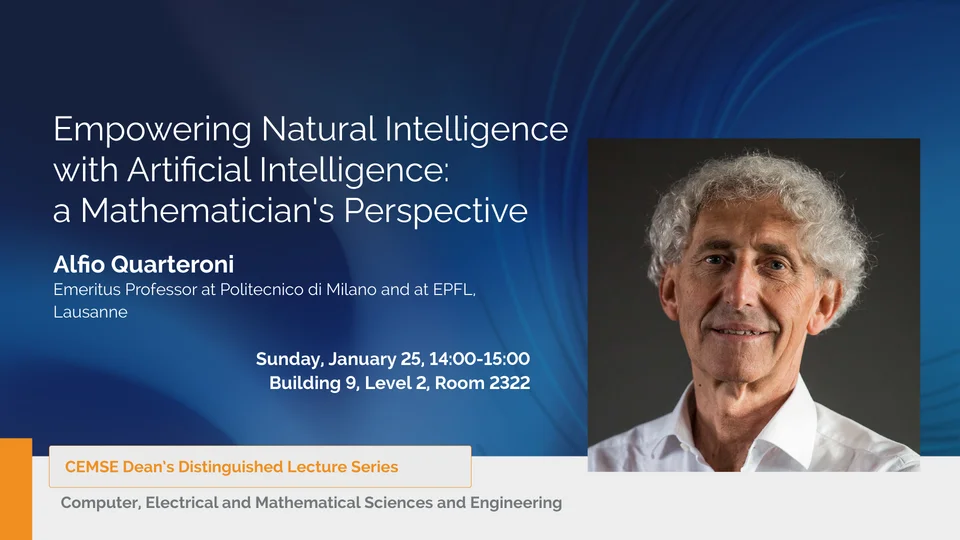
Empowering Natural Intelligence with Artificial Intelligence: a Mathematician's Perspective Alfio Quarteroni, Emeritus Professor, Politecnico di Milano and EPFL Jan 25, 14:00 - 15:00 B9, L2, R2322 Computational mathematics numerical methods Scientific Machine Learning scientific computing applied mathematics A Dean’s Distinguished Lecture on natural intelligence, artificial intelligence and scientific machine learning.
Tales of a Spur Hunter: The Wandering Spur Michael Peter Kennedy, Full Professor, School of Electrical and Electronic Engineering, University College Dublin Dec 7, 12:00 - 13:00 B9 L2 R2325 Prof. Michael Peter Kennedy presents the decade-long journey to diagnose and fix 'wandering spurs' in frequency synthesizers.
Will AI Replace Professors? Pavel Pevzner, Ronald R. Taylor Chair and Distinguished Professor, Computer Science and Engineering, University of California, San Diego Dec 4, 12:00 - 13:00 B2/B3 L0 A0215 This talk explores Massive Adaptive Interactive Texts (MAITs) as a pioneering AI technology that aims to replace the one-size-fits-all lecture model with a responsive and scalable system for individualized instruction.
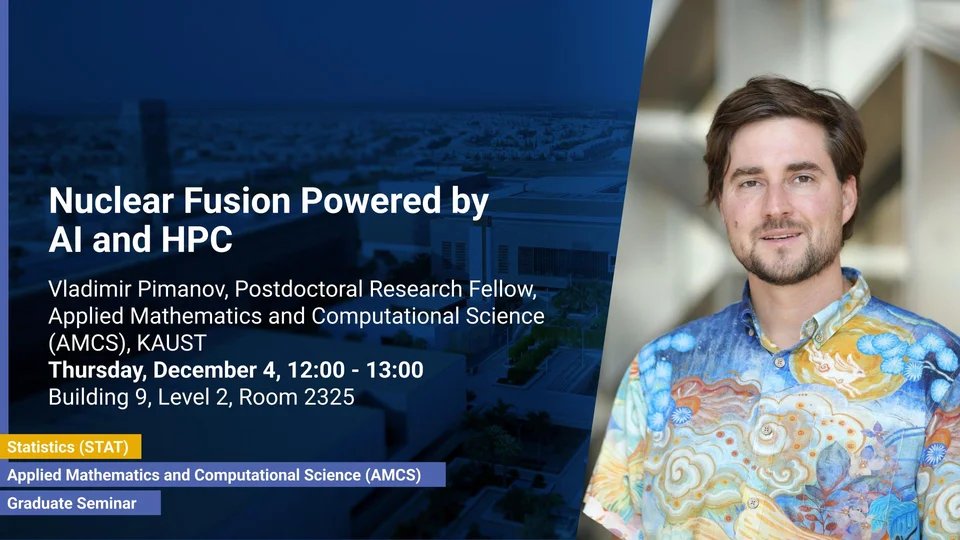
Nuclear Fusion Powered by AI and HPC Vladimir Pimanov, Postdoctoral Research Fellow, Applied Mathematics and Computational Science Dec 4, 12:00 - 13:00 B9 L2 R2325 AI artificial intelligence Fusion simulation This talk presents advanced simulations with AI-driven optimization to improve the performance of a next-generation plasma-jet-driven magneto-inertial fusion concept.
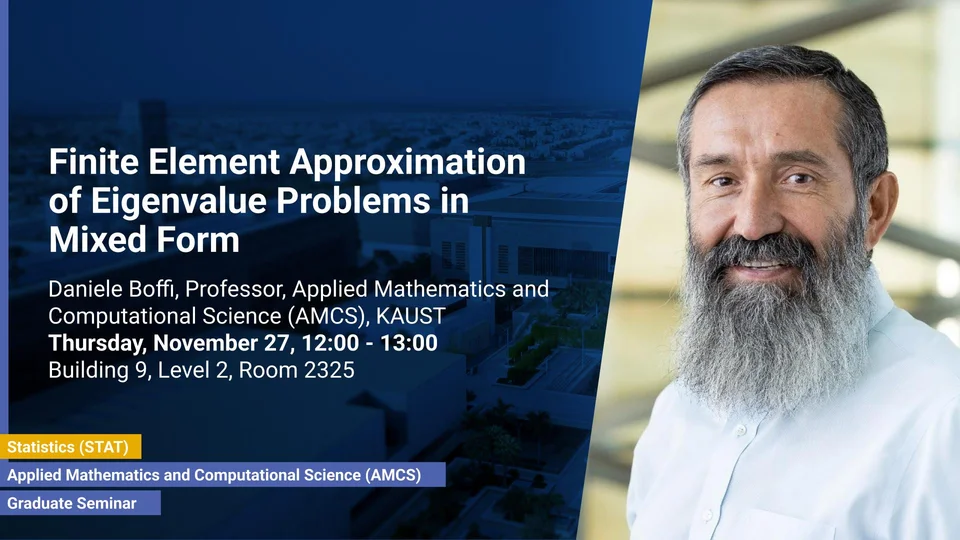
Finite Element Approximation of Eigenvalue Problems in Mixed Form Daniele Boffi, Associate Dean for Faculty, Computer, Electrical and Mathematical Sciences and Engineering Nov 27, 12:00 - 13:00 B9 L2 R2325 This talk will discuss the finite element approximation of the eigenvalues associated with the Maxwell system.
Daniele Boffi, Associate Dean for Faculty, Computer, Electrical and Mathematical Sciences and Engineering
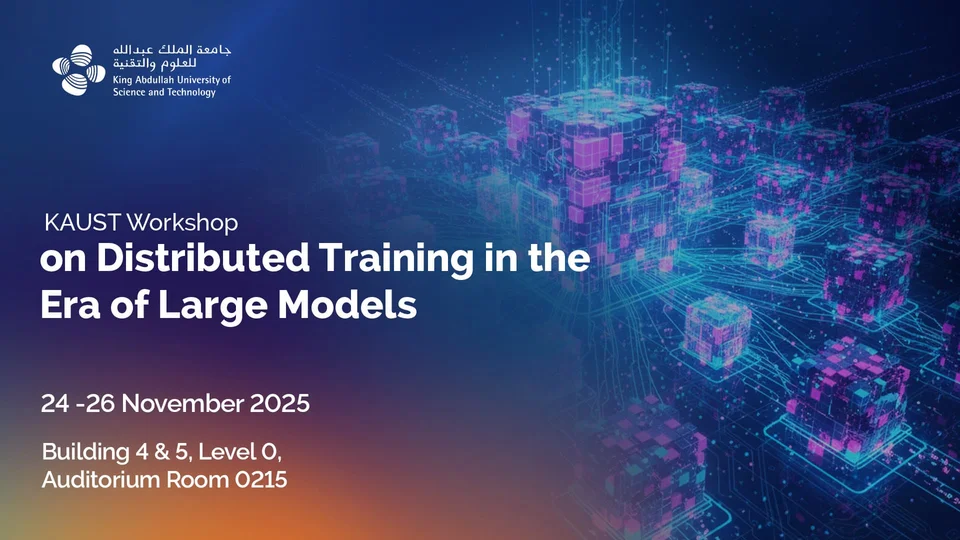
KAUST Workshop on Distributed Training in the Era of Large Models Nov 24 - 26, All day Auditorium between B4 & 5, L0, R0215 machine learning Distributed algorithms generative models ML Join leading researchers and innovators to explore how distributed training is reshaping the next generation of large-scale AI models.
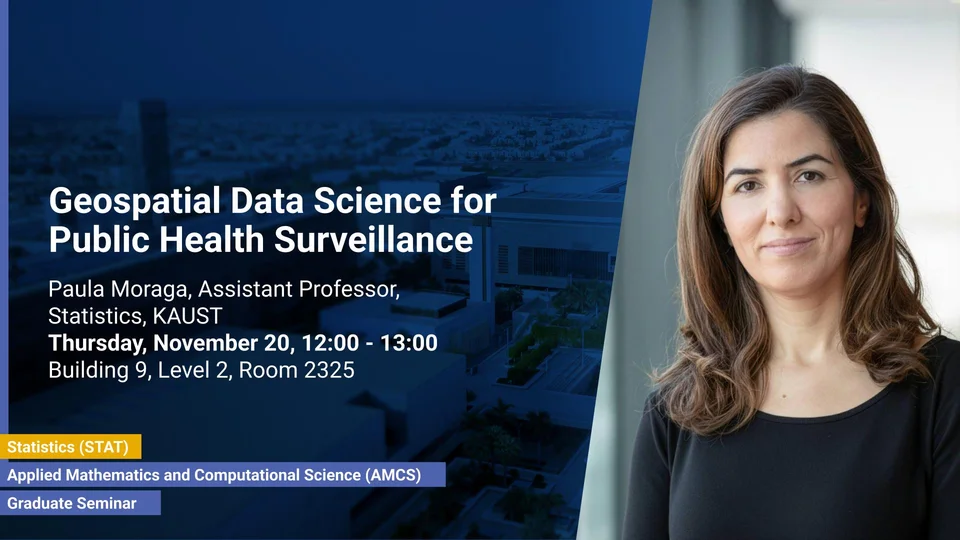
Geospatial Data Science for Public Health Surveillance Paula Moraga, Associate Professor, Statistics Nov 20, 12:00 - 13:00 B9 L2 R2325 statistical methods geospatial data analysis health surveillance Public Health spatio-temporal data analysis This talk will give an overview of statistical methods and computational tools for geospatial data analysis and health surveillance, highlighting challenges related to data biases and availability.
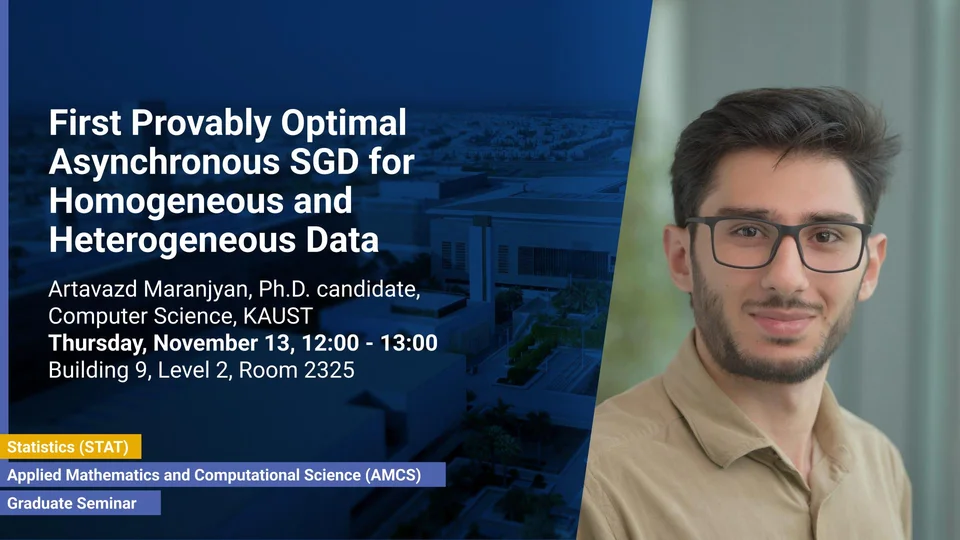
First Provably Optimal Asynchronous SGD for Homogeneous and Heterogeneous Data Arto Maranjyan, Ph.D. Student, Computer Science Nov 13, 12:00 - 13:00 B9 L2 R2325 machine learning optimization asynchronous algorithms Training This talk will discuss how to design asynchronous optimization methods that remain fast, stable, and even provably optimal.